An Electrical Installation Condition Report (EICR) is not a walk-round. It is a periodic inspection of the fixed wiring, written up to BS 7671, and most of the time on site goes on testing circuits one at a time. Knowing the order of a proper visit helps you plan access and tell your tenant what to expect.
Quick answer
The inspector agrees the scope, looks over the installation with the power on, then tests every circuit in turn: first with the power off, then with it back on. Expect them on site for hours, not minutes, and expect the power to go off and on while they work. Every reading and finding then goes into the report.
Key takeaways
- Anything the inspector can’t reach is written into the report as a limitation. Read those first.
- Many findings, such as missing bonding, are found just by looking.
- Most tests need circuits switched off one at a time, so warn your tenant.
- A whole house in thirty minutes means the circuits weren’t tested.
On arrival: ID, the scope and the limits
The inspector shows photo ID, then agrees with you or your tenant what is being inspected and anything that can’t be reached, such as a boarded loft. Those areas are written into the report as limitations, and they are the first thing to read on any EICR.
Limitations
The parts of the installation the inspector couldn’t inspect or test, and the reason. Some limits are normal, such as a sealed-off loft. A report that leaves out whole floors or most circuits doesn’t show the installation is safe.
The visual inspection
With the power still on, the inspector looks over the consumer unit, cables, sockets, switches, light fittings and bathrooms, plus the earthing and the bonding to gas and water pipes. They are looking for signs of heat, damage, DIY work and missing covers. Many C2 findings, such as missing bonding, are found just by looking.
The dead tests: power off, circuit by circuit
Continuity of protective conductors
Checks that the earth path is unbroken from the board to every point, and that ring circuits really are complete rings. A broken earth looks fine until something goes wrong.
Insulation resistance
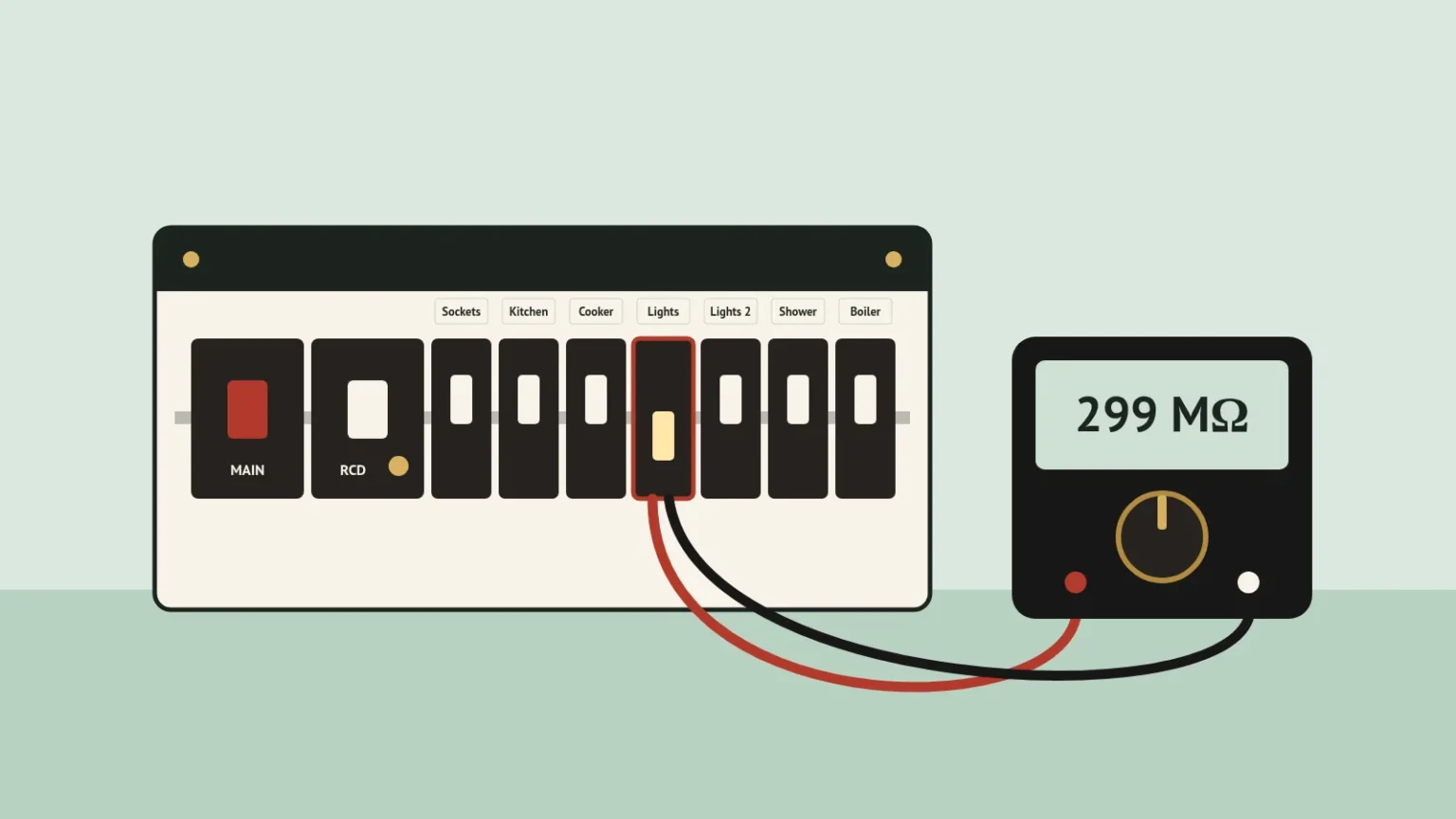
A test voltage is applied between conductors to find damaged or deteriorating cable insulation, usually reported in megohms. Low readings point to damage, damp or ageing cable before it shows.
Polarity
Confirms that switches and protective devices are in the line conductor, not the neutral, so “off” really means off. Reversed polarity can leave a light fitting live when it is switched off.
The live tests: power back on
Earth fault loop impedance
Measures whether enough current would flow in a fault to trip the fuse or breaker fast enough, compared with the limits in BS 7671. This is the test that shows the protection would actually work.
RCD tests
Each RCD is tripped with a test instrument and its trip time recorded, and the test button on the device is pressed too. Missing RCD protection where it’s needed is one of the most frequent findings.
The tests at a glance
| Test | Power | What it shows |
|---|---|---|
| Visual inspection | On | Heat damage, DIY work, missing covers, earthing and bonding |
| Continuity of protective conductors | Off | An unbroken earth to every point, and complete ring circuits |
| Insulation resistance | Off | Damaged, damp or ageing cable insulation |
| Polarity | Off | Switches and protective devices in the line conductor |
| Earth fault loop impedance | On | Whether a fault would trip the protection fast enough |
| RCD tests | On | Each RCD’s trip time, and that its test button works |
How long it takes
Hours, not minutes. Every circuit is isolated and tested in turn, so the usual time on site is:
- Studio or 1-bed flat: about 1.5 to 2.5 hours
- 2–3 bedroom home: about 2.5 to 4 hours
- 4–5 bedroom home: about 4 to 6 hours
- HMO: half a day to a full day, common parts included
Older wiring, extra consumer units and outbuildings add time. If someone offers to do a whole house in thirty minutes, the circuits weren’t tested.
Example
A 2-bedroom flat with one consumer unit and a 9am start: plan for the inspector to be there until around midday, possibly 1pm. Tell your tenant the fridge-freezer, broadband and any alarms will lose power at times during the morning, not all at once.
Before the visit: what to tell your tenant
- Agree a time, and who will let the inspector in if you won’t be there. Your tenant or agent can do it.
- Warn them the power will go off for periods: fridges and freezers, broadband, alarms and anything medical.
- Ask for access to every room, the consumer unit and, where possible, the loft and any outbuildings with electrics.
- Tell us about any equipment that can’t lose power, so the inspector can plan around it.
Our guide to getting a rented property ready for an EICR goes through access room by room.
After the visit: the report
Every reading goes into the schedule of test results, every finding gets a code, and the installation is marked satisfactory or unsatisfactory overall. Our guide to the C1, C2, C3 and FI codes explains what each one means. We send the full report as a PDF within 48 hours of the visit.
Landlords in England: what to do with the report
- Give a copy to your existing tenants within 28 days of the inspection, and to a new tenant before they move in.
- If the council asks for it, send a copy within 7 days.
- Any remedial or further investigation work must be done within 28 days, or sooner if the report says so. Then send written confirmation to your tenant and the council within 28 days of finishing.
Source: GOV.UK, Electrical safety standards in the private and social rented sectors: guidance. Councils can fine landlords up to £40,000 for a breach.
Questions landlords ask
Do I need to be at the property?
No. Your tenant or agent can let the inspector in. They need access to every room, the consumer unit and, where possible, the loft and any outbuildings with electrics. Areas that can’t be reached are recorded as limitations.
Will the power be off the whole time?
No, for periods. Most tests are done with circuits switched off one at a time, so the power goes off and on during the visit rather than staying off.
Can any electrician do an EICR?
Not necessarily. The rules for rented homes require a person qualified and competent to inspect and test. Many electricians install but don’t do periodic inspections, so ask for an inspection and testing qualification and a scheme registration you can check.
Want a fixed price before anything is booked? Find a qualified EICR electrician near you or ring 020 3386 1854.